Tuesday, April 4, 2017

Where are the good jobs in the next decade?

Where are the good jobs in the next decade?
by Wayne King

In the next decade the fastest growing sector of job growth worldwide will be those jobs associated with moving toward a renewable energy future and creating smart grids and a Third Industrial Revolution infrastructure to carry locally produced and distributed energy.

China recently announced that they would pour 82 Billion dollars into creation of a smart grid.

This is the very sector of our economy that Donald Trump has suppressed.

Its not that these jobs will move elsewhere. One of the largest benefits to locally produced, renewable energy is that it produces local jobs to build it and the long-term jobs stay local as well. They will just not be grown here where we are desperately seeking ways to create jobs that can replace the well paying jobs of the past.

The truth is that the jobs of the past are largely gone and no amount of huffing and puffing by politicians are going to bring them back. The battle for the future will be for the jobs of the future. Those countries that are building a Third Industrial Revolution infrastructure will have a massive competitive advantage.

If we targeted just 1/4 of the funds we use for infrastructure toward building this infrastructure of the future. We would produce millions more jobs than we are producing trying to revive the jobs of the past.

Here's just one example: I would be willing to bet that not one single NET new job will be produced in the coal industry in the next year. The companies will take advantage of the new Trump EPA to pass costs off to the public domain by polluting more - one change made recently allows coal companies to use public waterways for the disposal of wastes (hell it came out of the ground didn't it!) . But the coal companies will add more automation to take coal out of the ground, requiring fewer coal miners to do the job. The only bright spot is that the market for their coal is drying up faster than the RioGrande. Within a decade most of these companies will be gone. In the meantime owners will try to suck every bit of value that they can from their dying industry. Then they will throw up their hands and declare bankruptcy allowing them to walk away from their remaining debts.


Windows at an Exhibition

Wednesday, March 29, 2017

Green, Sustainable Energy is Here to Stay - Coal is Dead

Green, Sustainable Energy is Here to Stay - Coal is Dead
Wayne King

President Trump thinks that he is going to undo all of the good work that President Obama has done to put us on the road to clean and sustainable energy. Today he's going after the Clean Power Act but President Obama was smart. He used the crisis of 2008 to give a huge boost to wind and solar and other green energy sources and now they have market viability. Anyone who invests in carbon producing energy sources from here on is liable to lose their shirt and they know it. Coal is dead, we need to create new clean energy opportunities in the coal states and educate the people who live there to enable them to work in the industries of the future not the past.

But we need a smart grid to deliver and target energy resources. This will cost a lot of money but that money is already there.

According to the International Monetary Fund in 2015 they quantified the amount of money that is going into subsidies for fossil fuels and it was 5.4 TRILLION dollars. 6.5% of global GDP. What we have is not a technology problem, it is a political problem. Corrupt politicians and energy companies scratching to hold onto power in a system that is rapidly transitioning away from them have built a system where second industrial revolution energy is at an advantage over Third Industrial Revolution (TIR) Tech. We need to redirect those funds to build a new paradigm for distributing energy


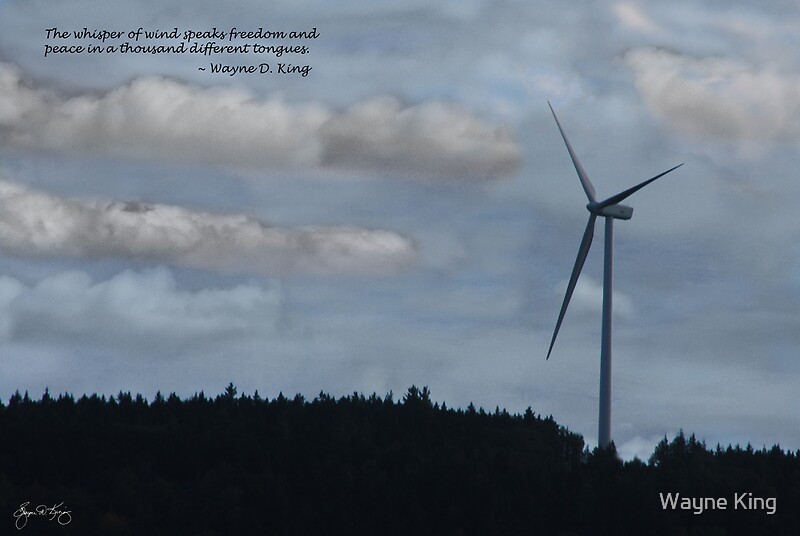
The Whisper of Wind Poster
http://bit.ly/2ow3IlH

Thursday, December 3, 2015

King Images chosen for "Fauna 2015" International Exhibition

Los Angeles-based Linus Gallery recently announced the winners of a call for artists in a juried competition titled "Fauna". Among those images chosen were two images by New Hampshire-based artist Wayne King. Chosen for the exhibition were "Pelican Mindscape" and "Knee Deep in Zebras".

"Pelican Mindscape" is a mixed media image combining elements of photography and painting. The image was printed from a negative through textured glass, hand-painted using Marshall oils and then scanned for output using archival inks in an edition of 100 16" x 24" prints, signed by the artist and available at an affordable $195. Unsigned images are also available from RedBubble.com: http://rdbl.co/1M4cPky 


"Knee Deep in Zebras" is a composite monochrome image created from a series of images of Zebras. Three editions of 10 prints each are available, two edition are toned in Blue and Brown respectively with the final a straight monochrome. Original prints are available from the artist at a cost of $495.00 for a 16"x24" signed print. Unsigned open edition prints are also available from Fine Art America: http://bit.ly/1XK6mia.


"I am honored to have had two images selected in this prestigious competition" said King. "The Linus Gallery is one of the most active and progressive galleries on the Web. It may also provide an opportunity for a visit to Lost Angeles where my sister resides - a great added benefit!"

Tuesday, November 11, 2014

Sacred Trust Chapter 3 has been posted

Sacred Trust Chapter 3 has been posted

Sacred Trust Chapter 3 has been posted. In the tradition of such great writers as Mark Twain, Harriet Beecher Stowe, Charles Dickens and Stephen King, "Sacred Trust" is being produced serially.  If you read it and hate it, let me know. If you read it and love it, tell me more! If you read it and have some ideas about where I should take the plot, the characters or the setting, that would be terrific. Feel free to give me some freestyle advice.

I'd also be interested in generating some donations for organizations doing important work so if you are willing to make a donation to a good cause and you want me to use your name or the name of your business or something like that in the story, send me a note with your offer and I'll do my best to accommodate you.

As I have said, the process here is not completely novel, though inviting collaboration seems to be somewhat unique. Releasing a book in parts, chapters or sections has been done by Mark Twain, Charles Dickens and Stephen King, to name a few. I don't claim to be deserving of a place in this august company - just making the point that I'm not plowing new ground completely. This plow has plenty of chips in the paint as near as I can tell.

So here we go - Section 1 "The Trust" introduces us to the cast of characters beginning with Charles Stonebridge in chapter one. In chapter two we met Douglas Fitzhugh Roy "Fitz"  and Sasha Brandt. Though you don't know it yet, Fitz and Sasha are quite possibly related - though they have never met before. Somewhere back in their family tree there is at least a loose affiliation with "The Peacemaker" and Hiawatha, two revered and historical figures that form a key constellation in the grand galaxy of Iroquois History. Sash is official - a card carrying member of the Iroquois nation. Fitz on the other hand is just a mutt with a past that likes hidden in a blue blood family's "shame".  

Chapter Three introduces Linda Levy a cop from Boston who has a grand affinity for the White Mountains and rock climbing. Growing up with her Cop father - also a rock climber - she was introduced to climbing in the Schuwangunks in northern New York but discovered the Rocks of Rattlesnake Mountain in the foothills of the White Mountains in her thirties and never looked back. Linda is also an attorney but she gave up her place in the bar to return to policing where her heart lay. Having dedicated nearly a half century to the law Linda is about to find herself on the other side of it. She doesn't know it yet but she is about to learn about the finer points of Civil Disobedience. 


The White Mountains
Calendar
Calendar with 13 beautiful images
Suitable for framing when the year ends!
See it here.

Wednesday, November 5, 2014

"I See the Way"


Order Open Edition Fine Art Prints here


I'm pleased to announce that "I See the Way" was chosen for the Regional NH Center for the Arts Juried show in New London. It has also been selected for a Judge's award among all the works. Awards will be presented at Friday's opening at the New London Inn Micro Gallery in New London - 5pm - 7pm. I plan to announce that 50% of proceeds from sales of a poster of the image will be designated to Project Laundry List a non profit NGO that works to advocate for a sustainable future and against regulations that prohibit wash lines.

Black Border
Order this poster here 
White Border
Order this poster here 
Order greeting cards here
White Border
Black Border 

Order Clock here


Sunday, June 8, 2014

Monarch Population Declines 90%


New Study: Loss of milkweed linked to plummeting number of Monarch Butterflies

According to a new study conducted by Prof. Ryan Norris and doctoral researcher Tyler Flockhart and a team of Scientists at the University of Guelph in Ontario, Canada, the dramatic decline in the monarch butterfly population in eastern North America is due largely to the steady loss of milkweed crops in U.S. breeding grounds.

Scientists at the University of Guelph say it provides the first proof of the critical connection between the monarch's sole source food and the declining population. Having picked apart the various factors linked to the drop in monarch butterfly populations - including climate change and storms in the wintering grounds for Monarchs - the researchers confirmed their theory that the lack of milkweed is likely the principle culprit in the chain and new anti-weed treatments for farm land may be the leading agent of the change.

Although originally thought to be caused by other forces in the region of Mexico where the Monarchs winter after a long migration, there is evidence that Monarchs have been able to recover regularly from storm related events that wiped out as much as 80% of the population at once. But the interruption of the breeding cycle, which takes place in a broad swath of both the US and Canada, seems to be placing the species in real jeopardy.

"Milkweed loss specifically in the midwestern U.S. is likely contributing the most to monarch declines, but the loses of the food species are occurring everywhere that the plant grows" according to Flockhart. The study was published in the Journal of Animal Ecology.

The reason that the midwest seems to have the dominant effect is quite simply that it is the corn belt and new techniques for enhancing the growth of corn and limiting the species considered to be "weeds" are having unintended consequences.


The plant is both the food source and the nursery for the species because, in addition to consuming its leaves the insect lays its eggs on it. It is also the only group of plants that monarch caterpillars feed on before developing into butterflies.

"Reducing the negative effects of milkweed loss in the breeding grounds should be the top conservation priority to slow or halt future population declines of the monarch in North America."

The study's findings, which are based on a mathematical model that includes all known factors linked to the decline of the butterflies, challenge long-held beliefs that their population drop was due to the degradation of their wintering grounds in Mexico. Mexican authorities have taken action to protect the wintering grounds but this new twist indicates that the attention has been in the wrong place and that action in the US and Canada will be needed to halt the drift toward extinction.

The authors say the loss of milkweed crops is likely not the only cause of the butterflies' falling numbers, but they're calling on governments to restore milkweed habitats.

Mexico, the United States and Canada agreed in February to form a working group on the conservation of monarch butterflies, with discussions expected to include milkweed restoration but we should not wait for government to address these issues. We can start immediately by planting milkweed in areas where they will flourish but not be subject to agricultural interference and particularly to the use of genetically engineered crops.

The Boy and the Monarch           Cards with this image             Fine Art Prints 


Links:


The Monarch Crusader


Friday, June 6, 2014

Phoenix Project Aims at Cleanup and Job Creation in Niger Delta

Phoenix Project Aims at Cleanup and Job Creation in Niger Delta
Creating Multiple Positive Outcomes from Spill Cleanup

Brief:
The Phoenix Project proposes to create a pilot "Enterprise Recovery and Empowerment Zone" in the Niger Delta of Nigeria to test an innovative approach to oil spill cleanup that includes creation of an enterprise community generating electricity, jobs and research opportunities for the people of the region.


You’ve probably seen the photos of the devastation in the Niger Delta. They were likely a sidebar story to coverage of the Gulf Oil Spill. As cleanup commenced here in the US within days of the accident, an equal amount of oil was being spilled in West Africa’s most fertile valley and richest fisheries and little was being done by anyone. Further, on an annual basis the Delta has experienced spills equivalent to two Gulf spills every single year.

Oil Companies find the inconspicuous nature of drilling and harvesting oil in Africa an attractive alternative to doing so in the West where consumers are more organized and unforgiving. Many of the local Nigerian politicians find that oil money makes a very tempting and large target for illicit proclivities. Add to all this a spill cleanup funding mechanism that suffers from a complete lack of transparency, further tempting even aspiring “honest” politicians and distancing oil companies from the assumption of responsibility and you have a recipe for an amoeba-like environmental catastrophe - growing and spreading as it devastates the economic and social fabric of the region. 

Enter Project Phoenix, the conceptual brainchild of former NH Senator Wayne King of with the help of his Nigerian counterpart Osita Aniemeka. King began going to Nigeria in 1997, shortly after an unsuccessful run for Governor, Leading a team of social entrepreneurs on behalf of the Ford Foundation, King’s team, which included Santa Barbara-based Philip “Kip” Bates of the University of California, Santa Barbara who was the technology guru of the Team. Rounding out the team was the late Dr. Chidi Nwachukwu a native born Nigerian and US Citizen and CEO of Sameday Express and a unique startup called UConnet that was one of the nation’s very first companies to use the Internet for telephone services, now referred to as “Internet Telephony”. Since 1997 the team has continued to return to West Africa for Ford Foundation, USAID and the World Bank among others. Dr. Nwachukwu died from Leukemia in 2000, when the idea for doing something about oil spills in the Niger Delta was little more than a glimmer in the eyes of the trio, and the team has dedicated this pilot project in his honor.

The Phoenix Project officially has been in the works for more than four years when King got the idea that it might be possible to build an “Enterprise Community” around the oil spill cleanup process where the cleanup and associated funds - if they could be accessed - would drive the development of both cleanup jobs as well as jobs related to the bi-products of the cleanup, specifically electricity, biochar, and biofuels. The more the team began to explore and research the components they envisioned the mmore they came to realize that there may be a way to make the effort sustainable, replicable and taken as a whole - carbon-negative. The Kyoto accords, that took effect in 2005, also spurred the idea that there might also be an opportunity for Carbon Credit trading based on the Carbon-Negative

In most circumstances today the end results of an oil spill cleanup are hidden from the public, quite possibly because the companies want the problem and its accompanying bad publicity to simply go away. “This means” said King, “that the opportunities to generate revenues from the cleanup of the oil and the treatment of the oil contaminated absorbents - like booms - go unnoticed and and untapped. Our pilot project recovers and recycles as much of the oil as we can, using a patented cellulose absorbent from MOP Environmental Solutions for the cleanup on both land and water (MOPenvironmental.com) then using the remaining biomass (the cellulose after oil removal) to generate electricity with a small, mobile, pyrolysis power plant manufactured by EcoReps of Adelaide Australia (www.Ecoreps.com.au). In addition to the electricity, the plant will also produce biochar a highly acclaimed soil amendment that has properties that make it both a fertilizer, a water storage element and a carbon sink - capturing carbon dioxide from the atmosphere and sequestering it for decades and perhaps centuries, releasing it only when called on for plant growth.” 

In addition to the jobs and opportunities created by the obvious products and processes The Phoenix Project - Niger Delta expects to seek out additional research and entrepreneurial opportunities that coincide with, and take advantage of, synergies that arise within the process. For example, research on biochar is at its very early stages and the use of it for bioremediation of oil spills is postulated but not thoroughly researched. Osita Aniemeka, Director of Nigerian operations, believes that the emphasis on research is consistent with Nigeria’s new emphasis on its agricultural sector and provides opportunities for the Phoenix Project to create jobs and ventures that empower women and young people who are particularly vulnerable to the economic woes brought on by these devastating and continuing oil spills.

Depending upon their ability to access oil spill cleanup funds and the extent of those funds, the Phoenix Project team believes that they can generate sufficient revenues to allow them to fund all or part of the cost of designating and cleaning up the next zone.

“We see this pilot project as our opportunity to develop an Open Source solution to the challenge of oil spills. Once we have tested the various aspects of the Pilot we will make the model available broadly to others who are seeking a solution to oil spills that creates a “Phoenix Effect” within an area devastated by a spill.” said Aniemeka.

The Phoenix Project is seeding the project with a crowd funding campaign on Indiegogo to raise the funds needed to bring together the communities, the experts and officials from both the government and the oil industry in the Niger Delta. They will also be carefully choosing the first site taking into account the long term needs of the community after the Enterprise and Empowerment Zone is turned over to a local governing body. “With a little luck”, King says, “we can move on to the next zone with most of the funds needed for the next cleanup, leaving a 1 megawatt electricity plant in the control of a local governing body to continue to provide badly needed and reliable electricity to the businesses and homes of the community.”  

The total cost of the pilot will be in the range of 12 million dollars but the companies participating as partners in the venture have all agreed to discount their costs in order to create the model. The net cost is likely to be closer to 8 million dollars, most of that for the capital equipment like the mobile power plant. “Once we have the model down right,” King continued “the net cost of each succeeding Zone should be somewhere in the range of $2 million dollars per zone, before calculating in revenues from most of the bi-products. While only the real thing will allow us to be sure, we are confident that after Zone one the process should be self sustaining - as long as there are funds available for the cleanup.” and in the Nigerian environment . . . that seems to be the biggest question mark.  

To learn more about the Phoenix Project you can visit the Project Phoenix Blog at nigerdeltaphoenix.blogspot.com

The Crowd funding effort can be viewed at http://igg.me/at/PPND